



How Long Does Radiesse Last?
About a year from one treatment — 68% were still improved at 12 months in the FDA-reported hands trial. Why the 'up to 2 years' claim needs context.
By Angelica Alcaraz, BSN, RN
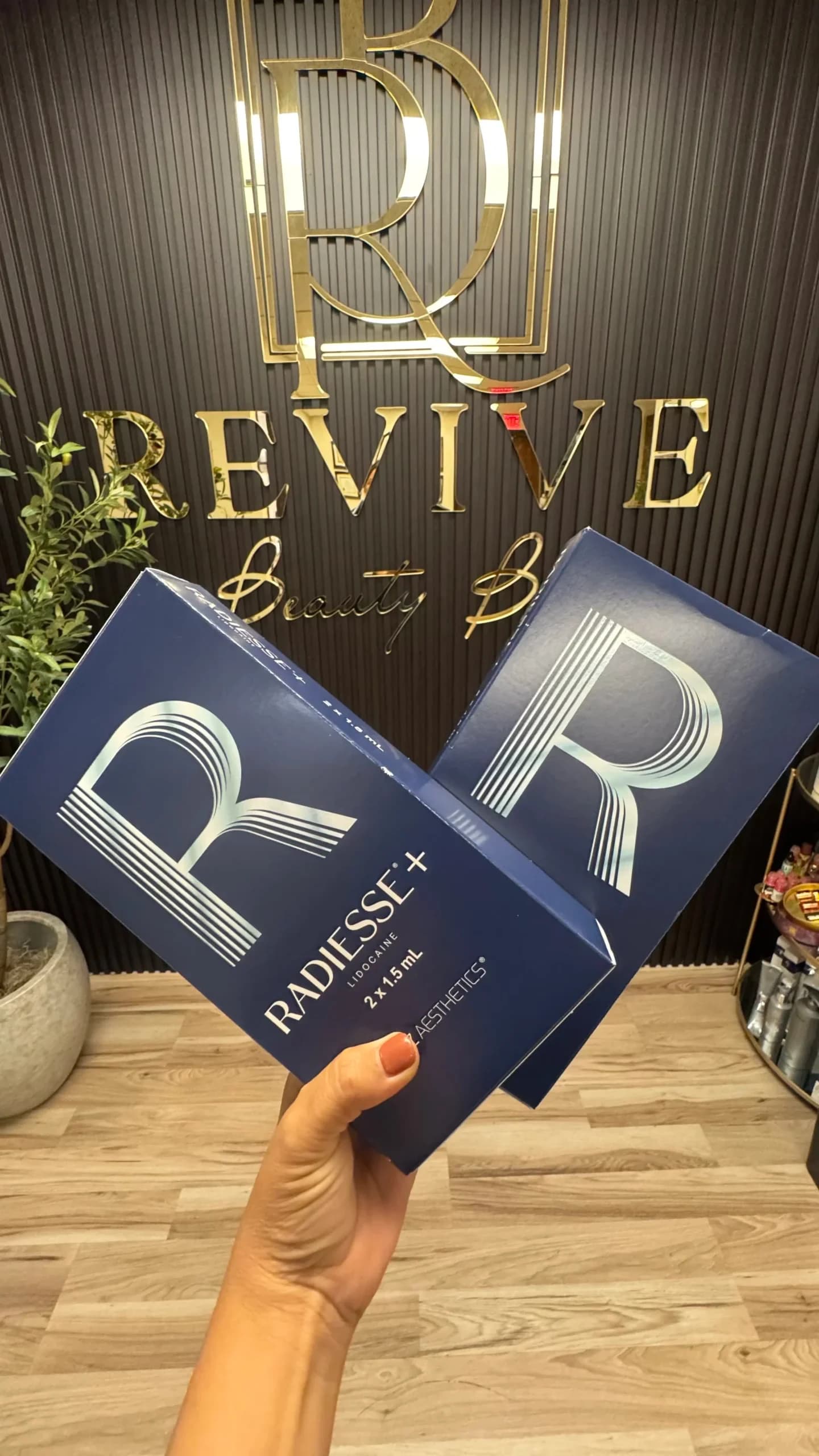
About a year from a single treatment is the honest answer, and the number you will see everywhere — "up to two years" — describes the best-case tail of a multi-treatment protocol rather than what one syringe does.
In the hands trial that the FDA labelling reports, 77% of patients still met the improvement threshold at three months and 68% at twelve. In the face, the manufacturer's own figures disagree with each other: the Radiesse website says results "have been shown to last up to 2 years," while Merz's jawline press release says "up to a year in most patients."
Here is what the trial data actually shows.
What Radiesse is
Radiesse is an injectable implant whose active component is calcium hydroxylapatite (CaHA) microspheres, 25 to 45 microns across, suspended in a gel carrier of sterile water, glycerin and sodium carboxymethylcellulose. That description is taken from the current FDA Instructions for Use.
One correction worth making, because it appears on almost every page about this product: the commonly quoted "30% microspheres, 70% gel" split does not appear in the FDA labelling. It comes from secondary literature. It may well be accurate; it is just not an FDA figure.
It is FDA-approved in the US for four things: moderate to severe facial wrinkles and folds such as nasolabial folds, and restoration of facial fat loss in people with HIV (both approved December 2006); volume loss in the back of the hands (June 2015); and — new this year — décolleté wrinkles, approved 8 April 2026, diluted 1:2 with saline.
The duration data, area by area
Hands — the cleanest single-treatment curve
This is the most useful dataset because the FDA labelling reports it as a straight follow-up after one treatment.
| Time after a single treatment | Still improved | Out of |
|---|---|---|
| 3 months | 77% | 113 |
| 6 months | 72.6% | 113 |
| 9 months | 71.4% | 35 |
| 12 months | 68.2% | 22 |
Read those last two denominators. Sixty-nine per cent of participants chose re-treatment at six months and left the untreated group, so "68% at twelve months" describes the 22 people who went a full year without a top-up. It is real, but it is a small and self-selected group — quite possibly the ones whose results were holding best.
Face — the six-month wall, and the three-year asterisk
The original nasolabial-fold trial randomised 117 patients to Radiesse in one fold and a collagen filler in the other. At three months, 84.6% of Radiesse-treated folds scored at least a point better than the control side; at six months, 78.6% did.
And then it stops. The pivotal facial trial has no efficacy endpoint beyond six months.
The "three years" figure in the labelling comes from a post-approval study that followed 102 of those patients out to three years. The label's own conclusion is that this demonstrates safety and effectiveness "up to 3 years after the date of first injection" — but in that same study the 102 patients received a mean of 3.7 Radiesse injections each, and every one of them was treated during the period. Fifteen per cent also had botulinum toxin and 9% had other fillers.
That is a maintained result, not single-treatment durability, and the distinction is the whole ballgame.
The single most useful published number comes from the peer-reviewed write-up of that cohort: 40% of the folds assessed at least 30 months after the last Radiesse treatment were still graded "improved" or better. Forty per cent, at two and a half years, after multiple treatments. That is the honest version of "up to two years."
Décolleté — studied to 84 weeks, so be careful with "2 years"
The 2026 approval is based on a 152-patient trial using a three-treatment regimen (day one, week six, week twelve) with Radiesse diluted 1:2 in saline. At week 24, 71.2% of treated patients met the improvement threshold against 6.3% of controls.
Responder rates then ran 72.6% at week 24, 65.9% at week 36, 73.3% at week 48 and 60.7% at week 60. The rise between weeks 36 and 48 is not the product getting better — 60.7% of the group took an optional re-treatment at week 36.
The labelling states plainly that safety beyond 84 weeks in the décolleté has not been investigated. Any "up to two years" claim for this area exceeds the study.
How long it takes to work, and to settle
Radiesse gives immediate volume from the gel carrier — that part is physically obvious in the chair. But the final result is a matter of weeks, and the best source for that is the FDA labelling's own warning against overfilling: "Do not overcorrect (overfill) a contour deficiency because the depression should gradually improve within several weeks as the treatment effect of RADIESSE injectable implant occurs."
In other words, some of what you see on day one is swelling, and the label tells injectors to plan for that rather than chase it.
Swelling in the face, from the trial diaries: about 18% resolved within one to three days, 22% within four to seven, 9% within eight to fourteen, and 5% took longer than two weeks.
Swelling in the hands is a different proposition and deserves saying out loud: 99.1% of participants in the hands trial experienced it. Among those with severe events, swelling lasted a median of 12 days and as long as 57. Nearly half reported temporary difficulty performing activities. The labelling specifically instructs patients to remove rings before treatment and until swelling resolves.
Why it lasts: the two-stage mechanism
The gel carrier provides immediate volume and then resorbs — peer-reviewed reviews put the carboxymethylcellulose at roughly six to eight weeks, though the FDA labelling itself gives no figure.
The microspheres stay considerably longer and are thought to stimulate new collagen while they do. In the animal study reviewed by the FDA, CaHA particles remained encapsulated at the injection site from one through 36 months, with the beginning of particle breakdown appearing only in the 25- and 36-month specimens.
Human biopsy studies support the collagen part, with the caveat that they are small. Across four studies totalling roughly 33 patients, immature type III collagen rises first — measurable at two months, peaking around four — and then remodels toward mature type I collagen, which was still climbing at seven months. Those are small, non-randomised series, and the most quantitative of them used diluted Radiesse in the neck and décolletage rather than standard concentration in the face.
What changes how long it lasts
Area is the variable with actual data behind it — the three curves above differ, and the labelling sets different studied envelopes for face, hands and décolleté.
Volume and dilution are constrained by the label: more than 3 cc per hand per session has not been studied, and the only FDA-approved dilution is the 1:2 saline protocol for décolleté. Hyperdilution beyond that is off-label, though it has peer-reviewed support.
On metabolism, exercise and smoking: we found no trial evidence quantifying any of it. Injectors observe differences; nobody has measured them. Treat claims that your lifestyle will halve or double the duration as clinical impression.
The one thing to understand before booking
Radiesse cannot be dissolved on demand. There is no FDA-approved reversal agent for calcium hydroxylapatite — no equivalent of the hyaluronidase used to undo hyaluronic acid fillers. The FDA's own consumer guidance notes it may be difficult or impossible to remove fillers not made of HA.
If a lump or over-correction happens, the published approach is stepped: observation first, since many nodules resolve as the material degrades; then mechanical dispersion, injecting saline into the area and massaging vigorously; then intralesional medications; with surgical removal as a last resort. Sodium thiosulfate is sometimes described online as a CaHA dissolver, but controlled work found intra-arterial CaHA still present after 24 hours regardless of concentration, and a published review calls it slow-acting and ineffective in an emergency.
This is the single biggest practical difference between Radiesse and an HA filler, and it is why injector experience matters more here than with a reversible product.
Two label points worth knowing: safety and effectiveness in the lips has not been established, and there are published reports of nodules when Radiesse is injected there. Safety in the area around the eyes has likewise not been established. Separately — and this is an FDA position about fillers generally rather than a Radiesse-specific one — the FDA identifies the area between the eyebrows, the nose, the forehead and the area around the eyes as the highest-risk zones for accidental injection into a blood vessel.
Finally, CaHA is radiopaque. Tell your doctor and any radiologist you see, because it shows up on imaging.
For the appointment itself, see what to expect before, during and after Radiesse and how to prepare for your Radiesse appointment. The Radiesse treatment page and the injectables overview cover what is offered here.
Angelica Alcaraz, BSN, RN, will assess your specific needs during your consultation.
Frequently Asked Questions
Ready to transform
your skin?
Schedule a free consultation to discuss which treatments are right for you.