



Targeted light-based skin correction
IPL Photofacial & Skin Rejuvenation in Salinas, CA
Target visible sun damage, brown spots and redness — without ablative resurfacing.
Revive Beauty Bar uses Spectrum Intense Pulsed Light for appropriately selected patients seeking improvement in selected pigmentation, vascular redness and photodamage.
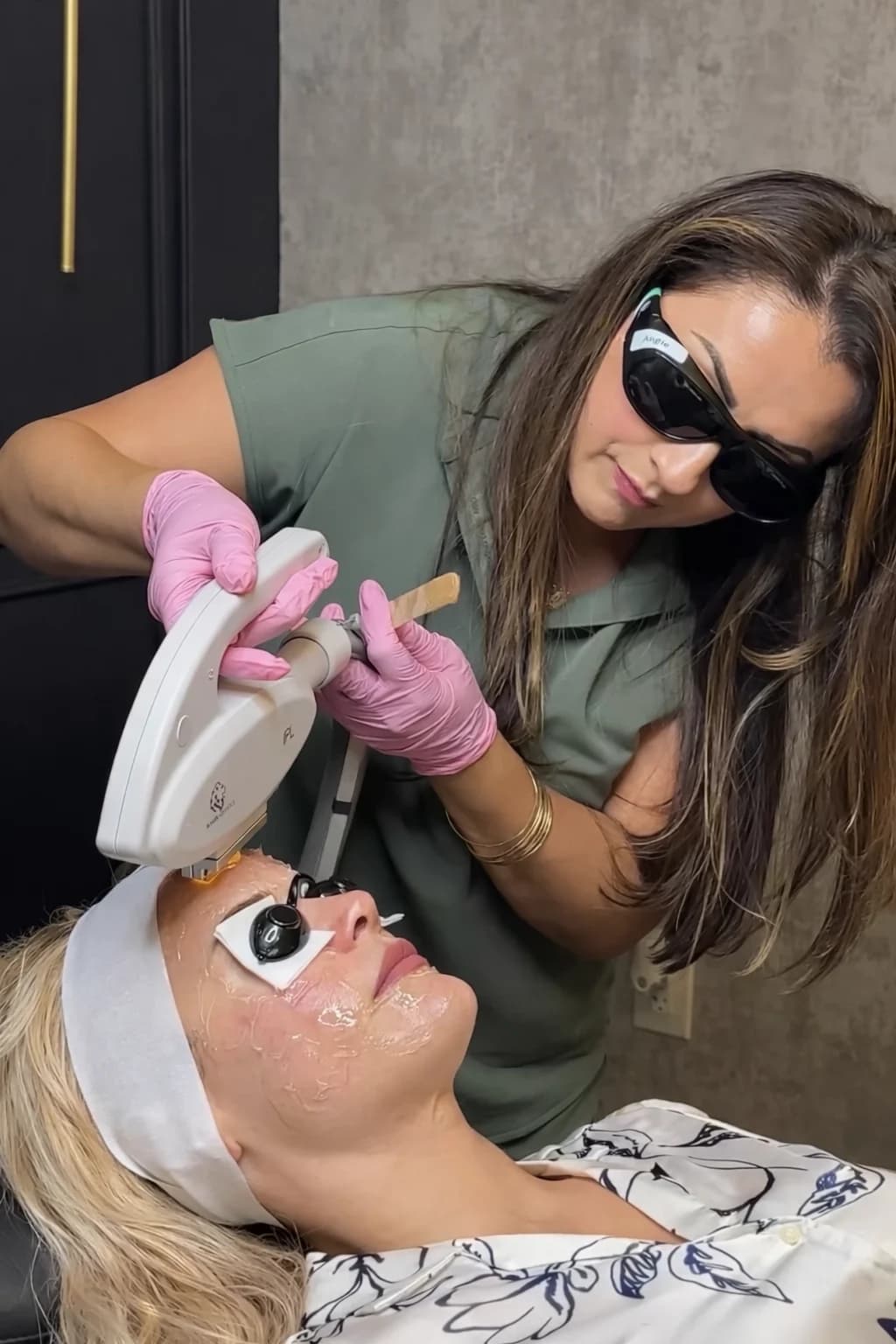
- Full face IPL
- $400
- Series of 3
- $999 prepaid
- Technology
- Spectrum intense pulsed light
- Skin types
- Fitzpatrick I–IV for listed indications
Serving Salinas, Monterey County and the surrounding Central Coast. Se habla español.
Getting the technology right
IPL Is Not a Laser, and It Is Not Resurfacing
IPL is intense pulsed light — a broad spectrum of light rather than a single laser wavelength — and it is not an ablative resurfacing treatment. Er:YAG resurfacing removes tissue. IPL does not.
The distinction matters to you, not just to us. It changes who is a candidate, what the recovery looks like, and which concerns the treatment can honestly address. If IPL is sold to you as a “laser facial,” you can end up with the wrong treatment for your skin.
IPL’s job at Revive is specific: light-based correction for sun damage, brown spots, redness and uneven tone in appropriately selected patients. Not a generic glow treatment, and not a substitute for resurfacing.
What IPL targets
Six Concerns IPL Is Actually For
IPL targets selected concerns and may improve their appearance. It does not remove, erase or permanently correct them, and it does not treat all pigmentation or all redness — diagnosis comes before treatment.
- 01
Selected brown spots and sun-related pigmentation
The clearest use of IPL at Revive. Discrete sun-related brown spots on the face, chest and hands are what the treatment targets most directly, and they are also what makes the change easiest to see in a photograph. Diagnosis comes first: not every brown mark is a sun spot, and a pigmented lesion needs assessment before it is treated with light.
- 02
Freckles and ephelides, where appropriate
Sun-induced freckling can respond to IPL when it is the right treatment for your skin type and history. Whether it should be treated at all is a conversation about your goals, because some patients want freckling softened and others want it left alone.
- 03
Diffuse facial redness
Generalized background redness across the cheeks and central face. IPL targets the vascular component of what makes skin read as flushed. This is not a claim to treat all redness — rosacea-associated redness, flushing triggers and inflammatory redness behave differently and are assessed individually.
- 04
Selected superficial vascular lesions
Fine visible vessels and telangiectatic redness at the surface, where they are superficial enough and the presentation is appropriate. Deeper or larger vessels are a different problem and light may not be the right tool for them.
- 05
Photodamage and uneven tone
The accumulated effect of Central Coast sun rather than any single spot: irregular tone, mottled colour, the general look of skin that has spent years outdoors. This is where a series matters more than a single session, because the change is cumulative.
- 06
Mild-to-moderate inflammatory acne, with the right filter
IPL has a role in mild-to-moderate inflammatory acne when the appropriate device filter and patient selection are used. It is one option among several here rather than the default — for many acne presentations the Aerolase NeoClear approach or a peel is the better starting point, and we will say which we think fits.
Transparent pricing
IPL Photofacial — Full Face $400
Published, not “call for pricing.” The series is the value option — we do not discount a single session to compete with low-price local IPL, because the value here is the technology, the patient selection and the safety judgement, not the speed of the appointment.
| Treatment Area | Price |
|---|---|
| Full Face | $400 |
| Face + Neck | $500 |
| Face + Neck + Chest | $575 |
| Hands | $250 |
| Small Focused Area | Starting $200 |
| Full Face Series of 3 | $999 prepaid |
The Full Face Series of 3 is $999 prepaid against $1,200 for three single sessions — a saving of $201. A series is recommended when the concern warrants it, and the number of sessions is decided by your skin rather than by the package.
Full Face — The anchor price and the most-booked treatment area.
Face + Neck — For photodamage that carries past the jawline.
Face + Neck + Chest — The comprehensive photodamage treatment across exposed areas.
Hands — A focused sun-damage area that is often overlooked.
Small Focused Area — Selected localized pigment or vascular concerns.
How it works
Broad-Spectrum Light, a Selected Filter, and Judgement
The Spectrum IPL handpiece delivers controlled pulses of broad-spectrum light into the skin. That light is preferentially absorbed by colour — the melanin in a sun spot, the haemoglobin in a visible vessel — which is what allows a pigmented or vascular target to take up more energy than the skin around it.
A filter selected by your provider narrows which part of the spectrum reaches the skin, so the same platform can be aimed at different concerns. Which filter and which settings are appropriate is a clinical decision made from your skin type, your recent sun exposure, the kind of pigment you have and your treatment history. There is no universal setting, and a device is only as safe as the selection behind it.
Revive owns the Spectrum platform alongside the Aerolase Neo Elite, the 810 nm diode for hair reduction and Er:YAG for ablative resurfacing. The reason to own several technologies is not to sell the machine you happen to have — it is to be able to say “not this one, that one” when your skin calls for it.
On wavelengths
We do not publish filter wavelength numbers on this page. Older and third-party Spectrum specification sheets list filters that current device labeling does not, and quoting a number we have not verified against our own handpiece and its device-specific manual would be worse than quoting none. Ask at your consultation and we will tell you exactly what is being used on your skin.
Choosing the right modality
IPL vs Aerolase vs Er:YAG
Revive owns multiple skin technologies. The goal is never to sell the machine — it is to select the right modality for the skin concern in front of us. None of these three is “better” than the others; they do different jobs.
- IPL Photofacial
- Selected brown spots, photodamage, redness and visible superficial vascular concerns. Low-to-moderate downtime, and treated pigment may darken before it sheds. Broad-spectrum light, not a laser.
- Aerolase Neo Elite
- A low-downtime 1064 nm laser option for selected pigment, redness, acne and skin quality, with broader skin-type flexibility than IPL. Typically low downtime. Where your skin tone or your pigment history makes IPL the higher-risk choice, this is often the modality we reach for instead.
- Er:YAG Resurfacing
- True ablative resurfacing for texture, scars, fine lines and more intensive surface renewal. Higher downtime by design. This is the treatment IPL is most often confused with, and they are not alternatives to each other — they answer different questions.
What this means for you
If your skin tone is deeper than the listed IPL indications support, or your concern is melasma, or you have had recent sun exposure, the honest recommendation is often not IPL. That is a feature of having options rather than a reason to be disappointed — and it is the conversation the consultation is for.
Candidacy
Who May Be a Candidate
Candidacy is individualized. These are the patterns, not a screening tool — the assessment happens in person.
IPL may be a fit if
- You have discrete sun-related brown spots on the face, chest or hands.
- You have diffuse facial redness or selected superficial visible vessels.
- Your main complaint is photodamage and uneven tone rather than texture or depth.
- Your skin types out in the Fitzpatrick I-IV range for the listed IPL indications.
- You can commit to strict sun protection and avoidance after treatment.
- You want visible correction without the recovery an ablative treatment requires.
IPL is likely the wrong tool if
- You have had significant sun exposure, a tan or self-tanner recently.
- Your skin tone is deeper than the listed IPL indications support.
- Your primary concern is melasma, which heat and light can worsen in some patients.
- What bothers you is texture, scarring or depth, which is a resurfacing question.
- You want a fixed, guaranteed number of sessions and a guaranteed outcome.
- You have a pigmented lesion that has not been medically evaluated.
What IPL Is Not
- IPL is not a laser. It is broad-spectrum intense pulsed light, not a single-wavelength laser.
- IPL is not Er:YAG resurfacing, and it is not an ablative treatment of any kind.
- IPL is not the same as the Aerolase Neo Elite, which is a 1064 nm Nd:YAG laser.
- IPL is not the preferred option for every pigment concern.
- IPL is not universally appropriate for Fitzpatrick V-VI.
- IPL is not a guaranteed melasma treatment and should never be sold as one.
- IPL does not replace medical evaluation of a suspicious pigmented lesion.
Skin type, sun exposure and pigment risk
IPL Should Not Be Marketed as Safe for All Skin Types
Spectrum’s current IPL indications specify Fitzpatrick I–IV. Higher epidermal melanin increases the risk of burns, blistering, post-inflammatory hyperpigmentation and hypopigmentation. Any clinic telling you a light-based treatment is safe for everyone is telling you something the labeling does not support.
So the assessment is careful and specific: skin typing, recent sun exposure, tanning history including self-tanner, the kind of pigment you have, your history of pigmenting after inflammation, and what is actually being treated. A recent tan is a reason to reschedule, not a detail to work around.
For patients with darker skin types or pigment-sensitive conditions, the Aerolase Neo Elite or another modality may be more appropriate depending on the concern. That is individualized modality selection — not a hierarchy where one device is always better.
What to expect
From Consultation to a Completed Series
01
Consultation
We evaluate skin type, recent sun exposure and tanning history, the kind of pigment you have, your redness pattern, medications and what you actually want changed. This is the step that decides whether IPL is the right modality for you at all, and it is where we say so if it is not.
02
Skin preparation
Makeup and skincare are removed and the treatment area is prepared according to protocol.
03
Eye protection
Appropriate protective eyewear is required — for you and for the provider. This is not optional and it is not a formality.
04
Treatment
Controlled pulses of broad-spectrum light are delivered through the Spectrum IPL handpiece using a provider-selected filter and settings chosen for your skin and your concern.
05
Immediate response
Warmth and temporary redness are common. Treated brown pigment may look darker straight after the session. That is an expected response, not a problem — and it is why the photograph taken an hour after treatment is never the “after” photo.
06
Early recovery
Selected pigmented spots may look darker before gradually flaking or fading over the following days.
07
Sun protection
Strict broad-spectrum sunscreen and sun avoidance matter after treatment. In an agricultural valley where a lot of our patients work outdoors, this is the part of the plan most likely to decide the result.
08
Series planning
Many concerns respond progressively. The number of sessions depends on the indication, your skin response and your treatment goals rather than on a fixed package number.
Pre-treatment guidance is provider-directed and based on your indication, the intensity planned, your skin response and your medical history — not a fixed rule sheet. One point worth stating plainly: do not stop a prescribed antiplatelet or anticoagulant medication before an IPL appointment unless your prescribing clinician tells you to. Tell us what you take and we will plan around it.
Recovery
Limited Social Downtime Is Not the Same as No Downtime
Most patients have limited social downtime, but temporary redness, warmth, swelling, darkening of treated pigment or mild crusting can occur. Recovery varies by treatment area, settings and individual skin response.
The response most people are not warned about is the pigment getting darker first. Treated brown spots can look more obvious for several days before they flake or fade. Knowing that in advance is the difference between a normal healing response and a phone call in a panic — and it is why we plan treatment around what you have coming up in the next two weeks.
Aftercare is directed by your provider based on the indication, the intensity used, how your skin responds and your medical history. We do not hand out a rigid post-treatment rule sheet that ignores which of those applies to you.
Results photography
Why There Are No Before-and-Afters on This Page Yet
Revive has no in-house IPL before-and-after series catalogued yet. We would rather publish nothing than show you another practice’s patients, or an Aerolase result relabelled as IPL — both of which are common enough elsewhere that it is worth saying out loud.
The standard the IPL series is being shot to: consistent lighting and camera settings; sun spots and photodamage, freckling and selected brown pigment, diffuse facial redness, chest photodamage and hand photodamage documented separately; session count and timeframe stated with every series result; no smoothing, filtering or alteration of pigment and redness; and never the immediate post-treatment darkening used as the final “after”.
In the meantime, ask at your consultation. Angelica will show you what is appropriate to show and tell you honestly what a realistic result for your skin looks like.
Who treats you
The Device Does Not Select the Patient. The Provider Does.
IPL is the treatment where patient selection carries the most weight. The same handpiece, the same filter and the same settings can produce a good correction on one patient and a pigmentary complication on another. What separates the two is skin typing, an honest history about sun and tanning, and a provider willing to say no or to reach for a different technology.
Angelica Alcaraz, BSN, RN, performs IPL at Revive Beauty Bar and assesses candidacy at consultation, including whether IPL is the right modality for your skin at all.
Common questions
IPL Photofacial FAQ
Related treatments
Other Ways We Treat Pigment, Redness and Photodamage
- Melasma & pigment →
- Where melasma is the diagnosis, a conservative 1064 nm approach is usually the safer starting point. Heat and light can worsen melasma in some patients, so modality selection matters more here than almost anywhere else.
- Rosacea & redness →
- IPL and Aerolase both reach the vascular component of facial redness. Which one fits depends on your skin type, your flushing pattern and your pigment risk.
- VI Peel & chemical peels →
- Chemical resurfacing for pigment, acne and tone, priced from $150 with the VI Peel at $350. A peel and an IPL series are different mechanisms, and for some pigment presentations the peel is the better first step.
- Er:YAG resurfacing →
- True ablative resurfacing for texture, scarring and fine lines. If depth and texture are what bother you, this is the honest answer even though the downtime is real. It is not what IPL does.
- Laser hair removal →
- Hair reduction is a dedicated 810 nm diode service at Revive, not an IPL service. The diode is the stronger positioning and the better tool for the job.
- Not sure which you need? →
- Pick the concerns that bother you and get a personalized starting point across every technology Revive owns.
Salinas & Monterey County
IPL Photofacial in Salinas & Monterey County
Revive Beauty Bar offers Spectrum IPL photofacial treatments in Salinas, California for appropriately selected patients seeking improvement in visible sun damage, selected brown pigmentation, redness and uneven tone.
The Salinas Valley gives people a particular kind of photodamage — years of cumulative outdoor sun on the face, chest, forearms and hands rather than one bad burn. That pattern, and the fact that a lot of our patients keep working outdoors after treatment, is why sun protection is part of the plan rather than a footnote to it. Se habla español.
- Studio
- 307 S Main St, Suite 130
Salinas, CA 93901 - Call
- (831) 272-2506
- Hours
- Mon–Fri: 11am – 6pmSaturday: 10am – 2pmSunday: Closed
Start With an IPL Consultation
A consultation covers your skin type, your recent sun exposure, the kind of pigment or redness you have, and whether IPL is the right technology for it. Angelica will assess your skin and recommend the modality that fits — even when that is not this one.