



How Many Laser Tattoo Removal Sessions Will You Need?
Most tattoos take a handful to a dozen-plus sessions, 6 to 8 weeks apart. A session estimator built from the Kirby-Desai scale, and how well it holds up.
By Angelica Alcaraz, BSN, RN
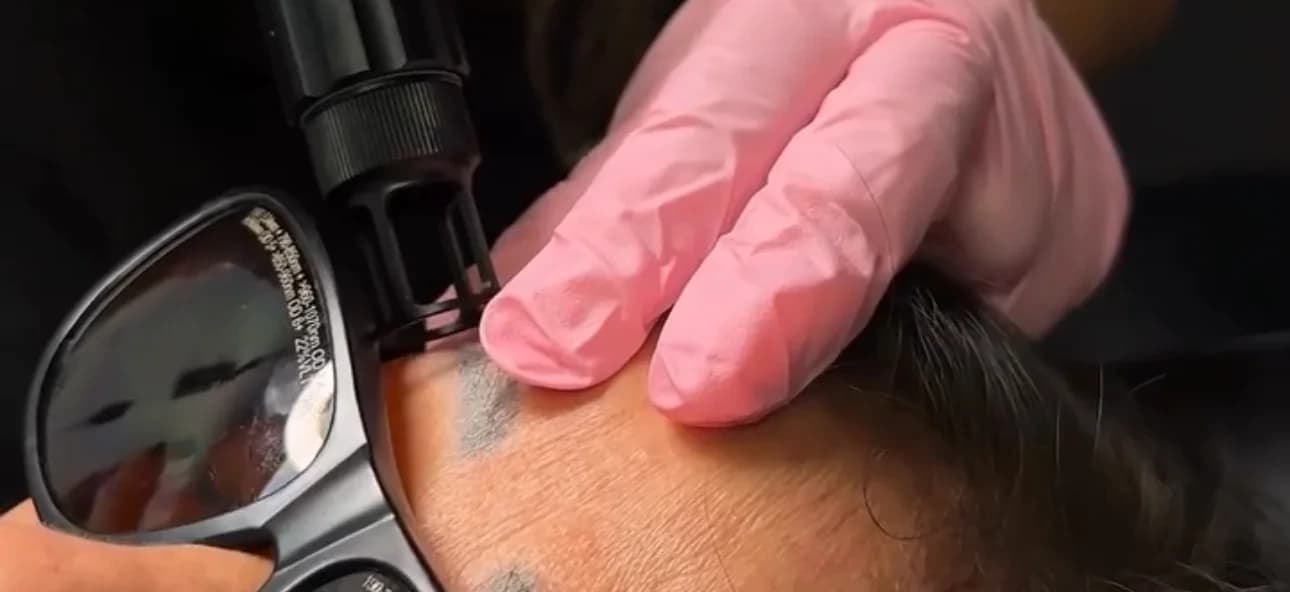
Most tattoos need somewhere between a handful and a dozen-plus sessions, spaced at least six to eight weeks apart, and nobody can give you an exact number before seeing how your ink responds. In the study behind the most widely used estimate, 100 patients needed an average of about 10 sessions, with a range of 3 to 20.
That estimate is the Kirby-Desai scale, and almost every "how many sessions" calculator online is built on it. Below is what the scale actually scores, a worked estimator built from its published tables, and the evidence on how well it holds up.
The Kirby-Desai scale, from the original paper
The scale was published in 2009 by Kirby, Desai and colleagues in the Journal of Clinical and Aesthetic Dermatology. It adds up points across six parameters. The authors propose that the total "correlate[s] with the number of treatment sessions required for satisfactory tattoo removal," assuming a Q-switched Nd:YAG or alexandrite laser with 6 to 8 weeks between treatments.
| Parameter | Categories and points |
|---|---|
| Skin type (Fitzpatrick) | I = 1, II = 2, III = 3, IV = 4, V = 5, VI = 6 |
| Location | Head and neck = 1, upper trunk = 2, lower trunk = 3, proximal extremity (upper arm, thigh) = 4, distal extremity (wrist, hand, ankle, foot) = 5 |
| Ink color | Black only = 1, mostly black with some red = 2, mostly black and red with other colors = 3, multiple colors = 4 |
| Amount of ink | Amateur = 1, minimal (one color, simple design) = 2, moderate (one color, complex design) = 3, significant (multicolored, complex) = 4 |
| Scarring or tissue change | None = 0, minimal = 1, moderate = 3, significant = 5 |
| Layering (a cover-up over old ink) | No = 0, yes = 2 |
The lowest possible score is 4 and the highest is 26. The authors flag tattoos scoring above 15 as ones that "may be difficult to remove."
Session estimator
These are illustrative tattoos scored with the tables above. The score is read as a rough session count.
| Example tattoo | Points (skin + location + color + ink + scar + layering) | Score | Rough sessions |
|---|---|---|---|
| Small black amateur symbol, upper back, skin type II | 2 + 2 + 1 + 1 + 0 + 0 | 6 | About 6 |
| Black single-color professional design, upper arm, skin type IV | 4 + 4 + 1 + 2 + 0 + 0 | 11 | About 11 |
| Mostly black with some red, chest, skin type IV, moderate ink | 4 + 2 + 2 + 3 + 0 + 0 | 11 | About 11 |
| Multicolor professional piece, lower back, skin type III | 3 + 3 + 4 + 4 + 0 + 0 | 14 | About 14 |
| Multicolor cover-up on the ankle, skin type V, minimal scarring | 5 + 5 + 4 + 4 + 1 + 2 | 21 | 20 or more, and may not fully clear |
Treat this as a conversation starter, not a quote. Two caveats matter more than the numbers.
First, the skin-type points are about safety, not biology. The authors explain that in deeper skin tones, operators "use lower laser settings and wait longer between treatment sessions" to limit pigment change. That is why Fitzpatrick IV to VI skin, common in Salinas, pushes the score up.
Second, the time adds up. Ten sessions at 6 to 8 week spacing is roughly 12 to 17 months from first visit to last.
How good is the scale? An honest look
The original study was a single-practice retrospective chart review: 100 patients from one tattoo removal clinic between 2004 and 2008, scored from history and photographs by one investigator. Patients who stopped treatment were excluded, and every one of the 100 included reached satisfactory removal. The mean score was 9.87 and the mean number of treatments 9.91, with a correlation of r = 0.757. That is a reasonable fit, but the authors themselves wrote that "further studies with more subjects are still needed to confirm the reproducibility of this scale."
Since then, small studies using newer techniques have found the scale tends to overestimate. A 2024 study of 11 patients averaged 5.09 sessions against a predicted 9.9 (one author works for the laser's manufacturer). A 2019 study of 22 patients with black amateur tattoos and skin types IV to VI, using a multi-pass technique, needed 1 to 4 sessions where the scale predicted 7 to 14. None was designed to validate the scale. The fair reading: Kirby-Desai ranks tattoos from easier to harder reasonably well, and predicts an individual count poorly.
The sobering counterweight is the largest outcome study we found: a Milan cohort of 352 patients treated with Q-switched lasers, where success meant removal without lasting side effects. Only 47.2% had reached it after 10 sessions, and 74.8% after 15.
What actually moves the number
Color. Black responds best. Revive uses the Spectrum Q-switched Nd:YAG, a nanosecond laser, at 1064 nm for black and dark pigment and 532 nm for red and some warm tones. Blue, green and yellow are not efficiently targeted at those wavelengths and commonly plateau. White, flesh-toned and cosmetic inks can darken paradoxically instead of fading, which is why brow and other cosmetic pigment is assessed separately, often with a test spot.
Amateur vs professional. Amateur tattoos tend to hold less ink, placed unevenly and more superficially. Professional work usually sits deeper and denser.
Location. Often described as "distance from the heart," but the paper's actual reasoning is blood and lymphatic supply, richest in the head and neck and thinnest at the extremities. The Milan cohort also found tattoos on the feet or legs responded less well.
Smoking. In the Milan cohort, smoking was associated with a reduced response; coverage of the study reported the chance of success after 10 sessions was about 70% lower in smokers. That is one observational study. The figure is often credited online to a 2014 paper; we traced it to this 2012 Archives of Dermatology cohort.
Spacing. Kirby-Desai assumes 6 to 8 weeks. The Milan cohort found intervals of 8 weeks or less were associated with a reduced response. No randomized trial has settled the ideal interval, but closer spacing is not faster and adds risk.
Do multi-pass or picosecond lasers cut the count?
Multi-pass methods. In the 2012 "R20" trial, 18 tattoos on 12 adults were split: a single pass on one half, four passes 20 minutes apart on the other. R20 was clearly better at three months. A 2013 study of the faster "R0" method, which uses topical perfluorodecalin to clear whitening between passes, included 22 previously treated tattoos plus small split comparisons, and R0 matched R20. Both were small.
Picosecond vs nanosecond. The split-tattoo trials, each treating half of a tattoo with each laser, disagree:
| Trial | Design | Result |
|---|---|---|
| Pinto et al., Br J Dermatol 2017 | 21 patients, 30 black tattoos, split, 2 sessions, 1064 nm | No difference in clearance; picosecond less painful |
| Lorgeou et al., JEADV 2018 | 49 patients, split | 75%+ clearance in 33% picosecond vs 14% nanosecond; no advantage in multicolor tattoos |
| Bäumler et al., JEADV 2022 | 23 subjects, 30 tattoos, split | Picosecond trended better, not statistically significant; less blistering |
| Ma et al., Plast Reconstr Surg 2026 | 30 subjects, split, 755 nm | Satisfactory clearance 73.3% vs 23.3% for picosecond, but more hyperpigmentation (21.3% vs 12%) |
A 2025 meta-analysis of 20 randomized trials put picosecond's advantage for tattoos and other external pigment at the edge of significance. Picosecond may help some tattoos and colors and is often less painful, but it has not consistently beaten nanosecond lasers on black ink. Neither guarantees complete removal.
Where this leaves you
Fading for a cover-up usually takes fewer sessions than chasing maximum clearance, so it helps to decide the goal first. Revive does not sell guaranteed-clearance packages; pigment is re-evaluated each session, and the next one is scheduled on healing and residual ink.
For size-based pricing and what the treatment involves, see laser tattoo removal in Salinas. The tattoo removal guide covers healing and risks in more depth, and permanent makeup and eyebrow removal explains why cosmetic pigment is handled differently.
Angelica Alcaraz, BSN, RN, will assess your specific needs during your consultation.
Frequently Asked Questions
From the treatment menu
Related treatments

Ready to transform
your skin?
Schedule a free consultation to discuss which treatments are right for you.