



How Many Aerolase Treatments Do You Need?
One session gave a median 48% lesion reduction in trial data, three gave 84%. What each Aerolase session does, how far apart they run, and why it is not permanent.
By Angelica Alcaraz, BSN, RN
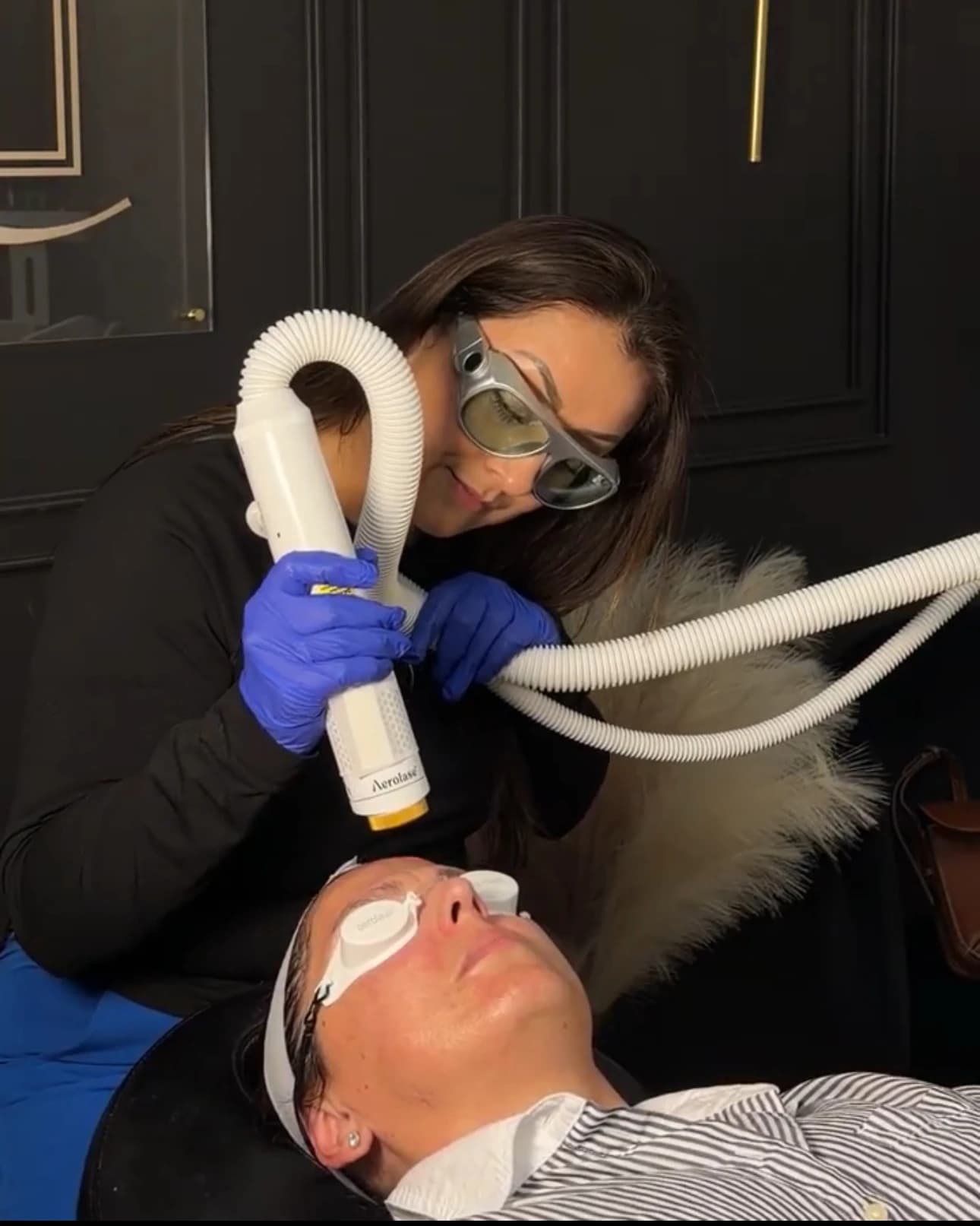
In the published studies, three treatments is the point where the numbers change decisively and five is the full course. A 225-patient review found a median of three treatments to reach clearance for facial acne. A separate trial running a five-treatment course at two-week intervals measured a median 48% lesion reduction after the first session and 84% by the third.
So: one session does something measurable. Three does most of the work. Five is the studied course. And none of it is permanent.
What one session actually does
This is the question people search for most, usually phrased as "Aerolase before and after one session" — and the honest answer is more encouraging than you would expect and less than the marketing implies.
In the 2024 study by Saedi, Griffin and Kelly in the Journal of Drugs in Dermatology, 23 subjects with mild to severe facial acne were treated five times at two-week intervals with the 650-microsecond 1064 nm Nd:YAG laser, without anaesthetic. The median reduction in lesion count after a single treatment was 48.15%. Sixty per cent of subjects said they noticed improvement after that first session.
Roughly half the lesions, from one visit, is a real effect. It is also the reason a single session is a poor test of whether the treatment suits you: you are seeing a little under half of what the course produced.
The session-by-session numbers
From the same five-treatment protocol:
| Point in the course | Median lesion-count reduction |
|---|---|
| After treatment 1 | 48.15% |
| At treatment 3 | 83.72% |
| 90 days after the final treatment | 86.67% |
Two things stand out. The jump from session one to session three is far larger than the jump from session three to the 90-day mark — most of the measured change had happened by the third visit. And the figure at 90 days was slightly higher than at treatment three, which is consistent with results continuing to settle after the course rather than fading immediately.
Subject satisfaction in that study tracked the same shape: 90% were slightly to highly satisfied after three treatments, and 90% said the treatment had improved their self-esteem after four.
What a bigger, messier dataset says
Trials are tidy. A retrospective review published in the Journal of Cosmetic Dermatology in 2024 looked at what happened in actual practice: 225 patients aged 14 to 61 with mild to severe facial acne, across Fitzpatrick types I–VI.
Those patients needed a median of three treatments to achieve clearance, and 48% reached complete clearance. Median Investigator Global Assessment scores moved from 3 (moderate) to 1 (almost clear), and were still there at the six-month follow-up.
That review also reports something the smaller trial did not. The most common adverse event was an acne flare, in 55.7% of patients, with dryness in 13.3% and much smaller rates of redness, swelling and itching. No serious adverse events occurred. The five-treatment trial reported that adverse events were not observed at all — a discrepancy worth knowing about before your first session, because a flare early in a course is common enough in the larger dataset that it should not be read as the treatment failing.
How to read these numbers honestly
Every figure above comes with a caveat, and you should have them:
- The trials are small. The five-treatment study had 23 subjects. The original double-blind sham-controlled trial by Kesty and Goldberg, published in the Journal of Cosmetic Dermatology in 2020, had 20 — it found Investigator Global Assessment improved 26% with the laser against 7% with a sham, which is a genuine result from a very small sample.
- The 225-patient review is retrospective, not randomized, and one of its authors is a consultant to the device manufacturer. That is disclosed in the paper and it is relevant.
- These are lesion-count reductions under study conditions, not a promise of clearance for any individual. Your own response depends on acne type, severity, skin type, hormonal factors and how consistently you complete the series.
Is Aerolase permanent?
No, and anyone who tells you otherwise is selling something. Aerolase does not permanently cure acne, melasma, rosacea, eczema or pigmentation.
What the data supports is durability rather than permanence: in the 225-patient review, the improvement in Investigator Global Assessment was still holding at six months. Acne is driven by hormones, sebum production and inflammation that do not stop because a course finished; melasma is driven partly by sun exposure and hormones, which also do not stop. Periodic maintenance is the realistic plan, not a failure of the first course.
At Revive, maintenance sessions after a completed series are $400–$450 at the established-patient rate. Building that into your thinking from the start is more useful than discovering it a year later.
So how many will you need?
The studies give you a defensible starting range — three to five — but the specific answer depends on things a study cannot see: whether your acne is inflammatory or comedonal, how severe it is, whether melasma or redness is in the mix, your skin type, and what else you are doing for your skin.
That is what the consultation is for, and it is free. Some people are told three is enough. Some are told a laser is not the right first step at all and that straightforward topical or prescription care should come first — which is usually cheaper and is not something Aerolase replaces.
What is worth avoiding is booking one session, judging the result against a before-and-after photo you saw online, and stopping. The evidence says one session is roughly the halfway mark.
If you want the full price picture, what Aerolase costs lays out the ladder and what changes it. For the evidence in more depth, including where it is weak, see our read of the clinical data, and what the treatment actually feels like covers sensation, side effects and aftercare. Every condition the device is used for here is listed on the Aerolase Neo Elite hub.
Angelica Alcaraz, BSN, RN, will assess your specific needs during your consultation.
Frequently Asked Questions
From the treatment menu
Related treatments

Ready to transform
your skin?
Schedule a free consultation to discuss which treatments are right for you.