



Aerolase Before and After: What the Results Actually Look Like
What Aerolase results actually look like: 48% median lesion reduction after one session, 84% by the third, and how the evidence reads across Fitzpatrick I–VI skin.
By Angelica Alcaraz, BSN, RN
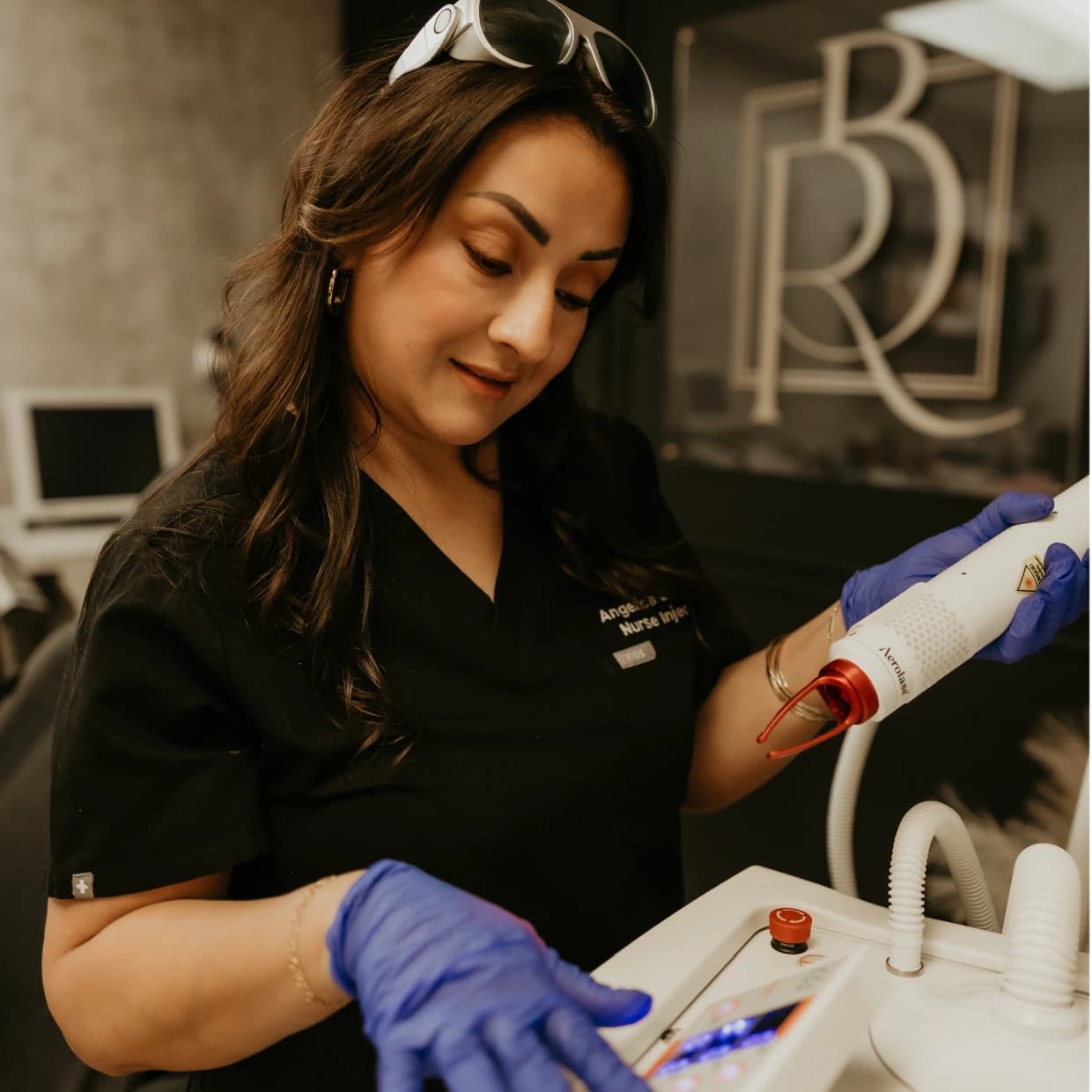
Across the published studies, the median change in acne lesion count is 48% after one treatment, 84% by the third, and 87% ninety days after the final session. In a 225-patient review across Fitzpatrick I–VI, 48% of patients reached complete clearance, at a median of three treatments — and the improvement was still holding at six months.
Those are the numbers behind the photos. This page is about what they mean for your face, and what a before-and-after picture can and cannot tell you.
What changes, and when
The most useful dataset is a 2024 study in the Journal of Drugs in Dermatology by Saedi, Griffin and Kelly. Twenty-three people with mild to severe facial acne were treated five times at two-week intervals with the 650-microsecond 1064 nm Nd:YAG laser, then followed up 90 days after the last session.
| Point in the course | Median reduction in lesion count |
|---|---|
| After treatment 1 | 48.15% |
| At treatment 3 | 83.72% |
| 90 days after the final treatment | 86.67% |
Sixty per cent of subjects noticed a difference after the first session. By the third, 90% were slightly to highly satisfied.
Read the shape of that curve rather than the endpoint. Most of the measured change is already done by session three, and the 90-day figure is slightly higher than the session-three figure — results keep settling after the course finishes rather than fading the moment you stop.
Results on darker skin
This is the part that matters most to people who have been turned away from other devices, and it is the strongest thing in the Aerolase evidence base.
The 1064 nm Nd:YAG wavelength is designed for Fitzpatrick I–VI. That is not marketing shorthand — it is reflected in who was actually in the studies.
A 2024 retrospective review in the Journal of Cosmetic Dermatology looked at 225 patients aged 14 to 61 treated in real practice. The cohort was 41% Caucasian, 38% African American, 9% Asian, 3% Hispanic and 9% other — a genuinely mixed group rather than a token few. Those patients needed a median of three treatments to reach clearance, 48% achieved complete clearance, and median Investigator Global Assessment scores moved from 3 (moderate) to 1 (almost clear), still holding at six months.
The five-treatment trial was similar: Fitzpatrick I–II made up 35% of subjects, III 9%, IV 30%, V 17% and VI 9%. More than half the participants were skin of color.
Longer wavelengths penetrate past the epidermis with less absorption by surface melanin, which is the physical reason this class of laser is used across deeper skin tones where some other devices carry more risk of burns and post-inflammatory pigment change. Suitability is still assessed person by person — a wavelength that is designed for a range is not the same as a guarantee for every individual in it.
Scars, pigment and redness
Acne has the most data behind it. The rest of what people photograph is less well studied, and it is worth being clear about which is which.
For post-inflammatory marks — the brown or red patches left behind after a breakout clears — improvement tends to follow the acne improvement, because you stop generating new ones. For textural acne scarring, meaning the pitted atrophic kind, this is not a resurfacing laser and it is not the tool that will fill a depressed scar.
For post-surgical scars, Aerolase may be used as part of an individualized scar-revision plan to improve selected redness, pigmentation and overall scar appearance, once the incision has fully healed and is medically appropriate for laser treatment. Nothing removes a scar, and no honest before-and-after will show one gone.
For melasma, pigmentation and rosacea, the same treatment ladder applies here, and the same limit applies to all of them: none of these conditions is permanently cured. They are managed.
Why we are not showing you a gallery yet
You came here for photographs, so this needs saying plainly.
Revive is building a before-and-after set that is shot consistently and published with documented patient consent, and until that exists this page carries the data instead of the pictures. The alternative — filling a gallery with clinical photos from elsewhere — is something this practice has explicitly ruled out. Photos from other clinics have circulated on this site's older pages, credited to other practitioners, and they are not Revive's patients.
That matters for you as a reader, because a before-and-after gallery is the easiest thing in aesthetics to fake and one of the hardest to verify. When you look at any clinic's results, including ours:
- Check the lighting and angle match. A brighter "after" under different lighting does most of the work in a surprising number of published pairs.
- Ask how many sessions and how long after. "After Aerolase" means nothing without "after four sessions, photographed at 90 days."
- Ask whether makeup was worn. A bare "before" against a finished "after" is not a comparison.
- Ask whose patient it is. Watermarks, tags and credits are worth reading.
If you want to see results in person, ask at the consultation. Angelica can talk you through what she has seen on skin like yours, and what she would and would not expect to change.
What a realistic expectation looks like
If you are treating inflammatory acne and you complete a course of three to five sessions two weeks apart, the published data supports expecting a substantial reduction in lesion count rather than clearance, with roughly half the change visible after the first session and most of it by the third.
It is worth knowing that the larger real-world review reported an acne flare in 55.7% of patients as the most common adverse event, along with dryness in 13.3%. No serious adverse events occurred. The smaller trial reported no adverse events at all. A flare early in a course is common enough in the bigger dataset that it should not be read as the treatment failing — but tell your provider if it happens.
And none of it is permanent. Acne, melasma and rosacea are driven by hormones, sebum, sun exposure and genetics, which do not stop because a course ended. Maintenance is the plan, not the failure of the plan.
How to read the evidence on this page
Both of the studies above are small or retrospective. The five-treatment trial had 23 subjects. The original double-blind, sham-controlled trial by Kesty and Goldberg, published in the Journal of Cosmetic Dermatology in 2020, had 20 — it found Investigator Global Assessment improved 26% with the laser against 7% with a sham treatment, which is a real result from a very small sample. The 225-patient review is not randomized, and one of its authors is a consultant to the device manufacturer, which the paper discloses.
These are reductions in lesion counts measured under study conditions. They are not a promise about your skin. Your own response depends on acne type, severity, skin type, hormonal factors and how consistently you finish the course.
For the full read on that evidence and where it is weak, see does Aerolase work. For what the appointment itself is like, see what Aerolase feels like. How many treatments you need covers the course in detail, and every condition treated here is listed on the Aerolase Neo Elite hub.
Angelica Alcaraz, BSN, RN, will assess your specific needs during your consultation.
Frequently Asked Questions
From the treatment menu
Related treatments

Ready to transform
your skin?
Schedule a free consultation to discuss which treatments are right for you.