



What Is PRF Treatment for the Face?
PRF is your own blood spun without anticoagulant into a fibrin scaffold. What the trials show for skin quality — and why nobody yet knows how long it lasts.
By Angelica Alcaraz, BSN, RN
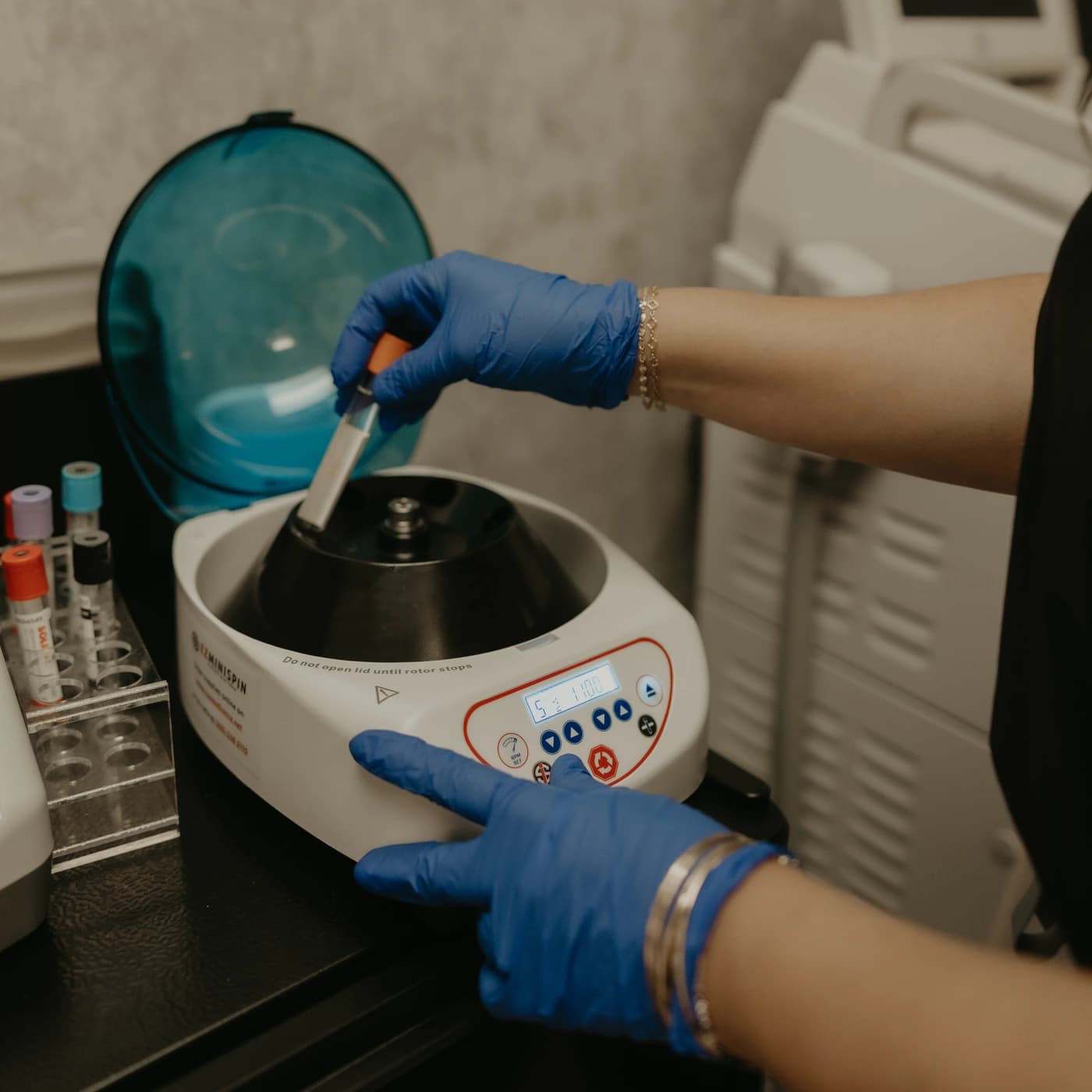
PRF is platelet-rich fibrin — your own blood, drawn and spun in a centrifuge without any anticoagulant, so clotting starts immediately and your platelets and white cells stay caught in a natural fibrin scaffold instead of floating loose in plasma. That scaffold is the entire point: it releases growth factors gradually rather than all at once.
It is a skin-quality treatment, not a filler. The published evidence supports improvement in skin thickness, density and texture. What it does not yet support is how long that lasts.
PRF vs PRP: the difference that actually matters
Most explanations of this get vague. The real difference is one ingredient and one spin.
| PRF | PRP | |
|---|---|---|
| Anticoagulant | None | Acid citrate dextrose added |
| Centrifuge | Single, slow spin — roughly 700–2,000 rpm for 2–5 minutes | Usually two spins, faster and longer |
| What you get | A fibrin matrix holding platelets and leukocytes | Liquid plasma with concentrated platelets |
| Growth-factor release | Gradual, over days in laboratory testing | A large early burst |
Those protocol figures come from a 2026 randomized split-face trial published in the Journal of Cosmetic Dermatology, which prepared PRF from 10 mL of blood at 1,100 rpm for three minutes with no anticoagulant, and PRP from 10 mL with 1.5 mL of acid citrate dextrose at 1,500 rpm for ten minutes.
Because there is no anticoagulant, the tube has to be spun immediately after the draw. Clotting has already begun.
One caution on the numbers you will see quoted elsewhere: rpm is meaningless without knowing the rotor size, and the reviews in this field say so explicitly. There is no single "correct" PRF speed.
The "releases growth factors for 10 days" claim
You will read this everywhere, so it is worth knowing exactly where it comes from.
It comes from one laboratory study — Kobayashi and colleagues, published in Clinical Oral Investigations in 2016, which measured protein release from samples taken from six donors at intervals out to ten days. PRP released more early; PRF released steadily across the full ten days.
That is a real finding and a reasonable basis for the design of the treatment. It is also six donors, in a dish, in an oral-surgery journal. It is not a measurement of how long anything lasts in a human face, and hundreds of pages that cite it are all citing that same single study rather than corroborating each other.
What the clinical evidence shows
The best synthesis available is a 2025 systematic review in the Journal of Cosmetic Dermatology covering periorbital — under-eye — rejuvenation. It reviewed 14 studies published between 2015 and 2025, five of them PRF, with individual studies ranging from 8 to 68 participants.
Typical protocols across those studies: two to four sessions, one to four weeks apart, 0.5 to 4.8 mL per session, delivered intradermally or subdermally with a fine needle or a blunt cannula.
The strongest single trial is a 2026 randomized, double-blinded, split-face study: 24 people completed it, average age 41, receiving three sessions four weeks apart with PRF on one side of the face and PRP on the other, followed for seven months. Both sides improved in hyperpigmentation and wrinkles. Both improved dermal density and thickness by month four. PRF produced a more stable reduction in melanin and redness. Neither was significantly better than the other overall, and 47% of participants found PRP the more painful side.
A broader 2025 review in Annals of Plastic Surgery pooled 20 studies and 514 patients across both PRP and PRF, and found significant improvement reported in 80% of the studies measuring skin thickness and 75% of those measuring elasticity. Hydration had the weakest support.
Where the evidence is weak — and it is weak
Anyone selling you PRF should tell you this part.
Nobody knows how long it lasts. This is the most important gap, and the 2025 review says it plainly: longer duration was one of the reasons PRF was developed, and whether it actually achieves that is unknown because nobody has watched patients long enough. PRF improvements "often diminished by six months." The longest follow-up in the entire body of work is seven months.
The one placebo-controlled trial lost its result. A 2021 split-face study in Aesthetic Surgery Journal injected 30 patients with a platelet-rich fibrin matrix on one side and saline on the other. At six weeks the treated side was significantly better (p = 0.003). At twelve weeks the difference was no longer statistically significant (p = 0.34). Note also that this study used a Selphyl-type matrix — anticoagulated PRP re-clotted with calcium chloride — which is not the same thing as PRF, though it is constantly cited as if it were.
Some of the early improvement may just be swelling. The reviewers raise this directly: there is conflicting evidence on whether short-term improvement reflects genuine tissue change or transient oedema. For an under-eye treatment, that is not a small caveat.
The studies are small and inconsistent. Sample sizes from 8 to 68. Only five of the 14 periorbital studies used objective quantification at all; the rest relied on photographs and scales. Centrifuge speeds, times and tube types vary so much that the reviewers say results cannot be reliably compared or reproduced.
PRF is not proven better than PRP. The 2025 review's own conclusion is that current evidence does not support the superiority of either. The one study that found PRF ahead of PRP for the outer-eye area saw that difference disappear by six months. PRP actually performs better for pigmentation.
Is PRF FDA-approved?
No, and the distinction matters.
Because PRF is made from your own blood and returned to you, it is regulated as a blood product rather than as a tissue product. The centrifuges and tubes used to make it are FDA-cleared medical devices under the 510(k) pathway, with intended-use language centred on preparing autologous platelet concentrate for bone-graft handling.
That clearance covers the device's ability to separate blood. It is not an FDA approval of PRF for facial rejuvenation, under-eye hollows, or any aesthetic purpose. Aesthetic use of PRF is off-label. Any page telling you PRF is "FDA-approved for the face" is wrong.
What about EZ Gel?
EZ Gel is a newer variation you will see offered, including here. Platelet-poor plasma is heated to about 75 °C for ten minutes, which denatures the albumin into a gel, then cooled and recombined with liquid PRF to make what the literature calls Alb-PRF.
The mechanism is coherent and the preparation is documented. But we could find no randomized human trials of it for under-eye hollows, tear troughs or facial volume — the published Alb-PRF trials are dental and oral. The frequently quoted "lasts four to six months" figure refers to laboratory work on how long the gel material takes to resorb, not to how long a cosmetic result lasts in a patient. Those are different things, and conflating them is the most common overstatement in this corner of aesthetics.
Treat EZ Gel as a plausible newer protocol with no published facial efficacy data yet, and judge it accordingly.
Safety
Across all 14 periorbital studies, only mild and transient effects were reported: swelling as the most common, usually settling within about 24 hours, plus redness, bruising and injection-site soreness. One vasovagal fainting episode occurred during a PRP treatment. No serious complications were reported, and adverse-event rates did not differ meaningfully between PRF and PRP. In the 2026 trial, 62.5% had mild swelling and there were no major complications over seven months.
Because it is your own blood, the risk of allergic or foreign-body reaction is minimal. There is no published dermatology-society contraindication list specific to cosmetic PRF, so decisions about bleeding disorders, platelet conditions, active infection or anticoagulant therapy are clinical judgements made at your consultation rather than something a website can answer.
Who it is and is not for
PRF is a reasonable option if your concern is skin quality — texture, fine lines, thin crepey skin under the eyes, overall density — and you are willing to do a short course of two to four sessions and accept that the durability data does not exist yet.
It is not a volumiser and not a filler substitute. If you want a hollow filled predictably and for a known duration, that is a different conversation, and an honest one should include hyaluronic acid filler as the comparison.
For the choice between the two platelet preparations, see PRF or PRP. The benefits and risks of PRF covers what to expect, PRF EZ Gel explains the treatment as offered here, and how to prepare for your appointment covers the practical side.
Angelica Alcaraz, BSN, RN, will assess your specific needs during your consultation.
Frequently Asked Questions
Ready to transform
your skin?
Schedule a free consultation to discuss which treatments are right for you.